
Sell waste cardboard and paper: grades, prices and how to sell
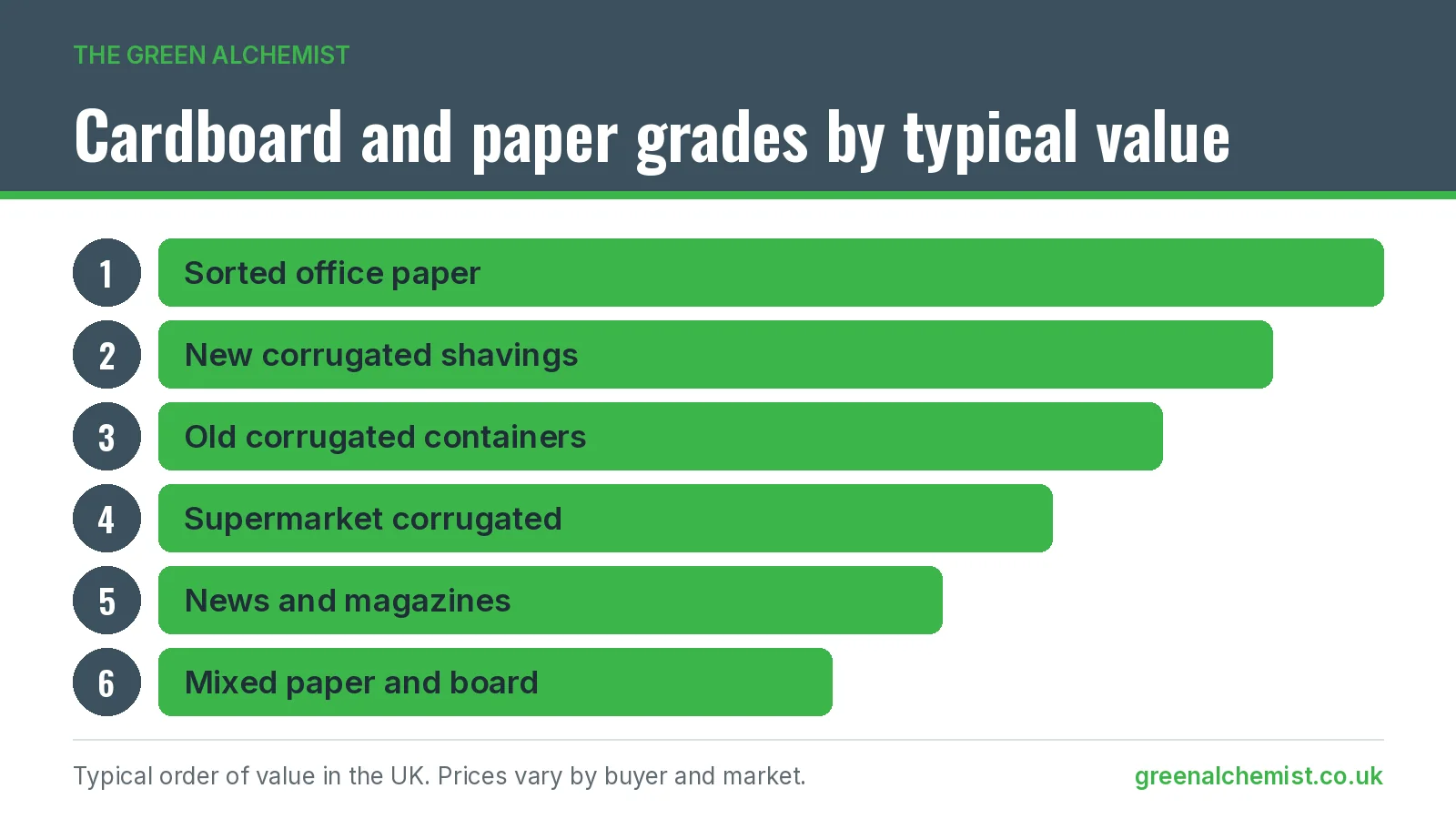
Clean, dry cardboard is traded by the tonne, and paper mills pay more for baled, sorted material. If you produce regular volumes, baling it can turn a collection charge into a rebate.
This guide is for businesses. If you are a householder, use your council's recycling service or your local recycling centre instead.
What is waste cardboard worth?
Cardboard and paper are sold per tonne. The price follows demand from paper mills in the UK and overseas, and it can change from month to month.
What you are paid depends on:
- Grade. Sorted cardboard and white office paper earn more than mixed paper.
- Moisture. Mills pay less for wet material and may reject it.
- Contamination. Plastic film, polystyrene, strapping and food all lower the price.
- Bales. Dense, mill size bales cost less to haul and earn more than loose cardboard.
- Volume. A full collection of bales earns far better terms than a few loose cages.
For current market figures, see our cardboard and paper prices page, which is updated every month.
Cardboard and paper grades
| Grade | What it is | Notes |
|---|---|---|
| Old corrugated containers (1.05) | Used corrugated boxes | The main cardboard grade |
| Supermarket corrugated (1.04) | Used packaging with a little other paper and board | Slightly below 1.05 |
| Mixed paper and board (1.02) | A sorted mixture of paper and board | The lowest common grade |
| Sorted office paper (2.05) | White office paper | Above cardboard |
| News and magazines (1.11) | Newspapers and magazines for deinking | Priced as its own grade |
| New corrugated shavings (4.01) | Clean factory offcuts of new board | The best brown grade |
The numbers come from EN 643, the European list of standard grades that mills and merchants use.
How to prepare cardboard for sale
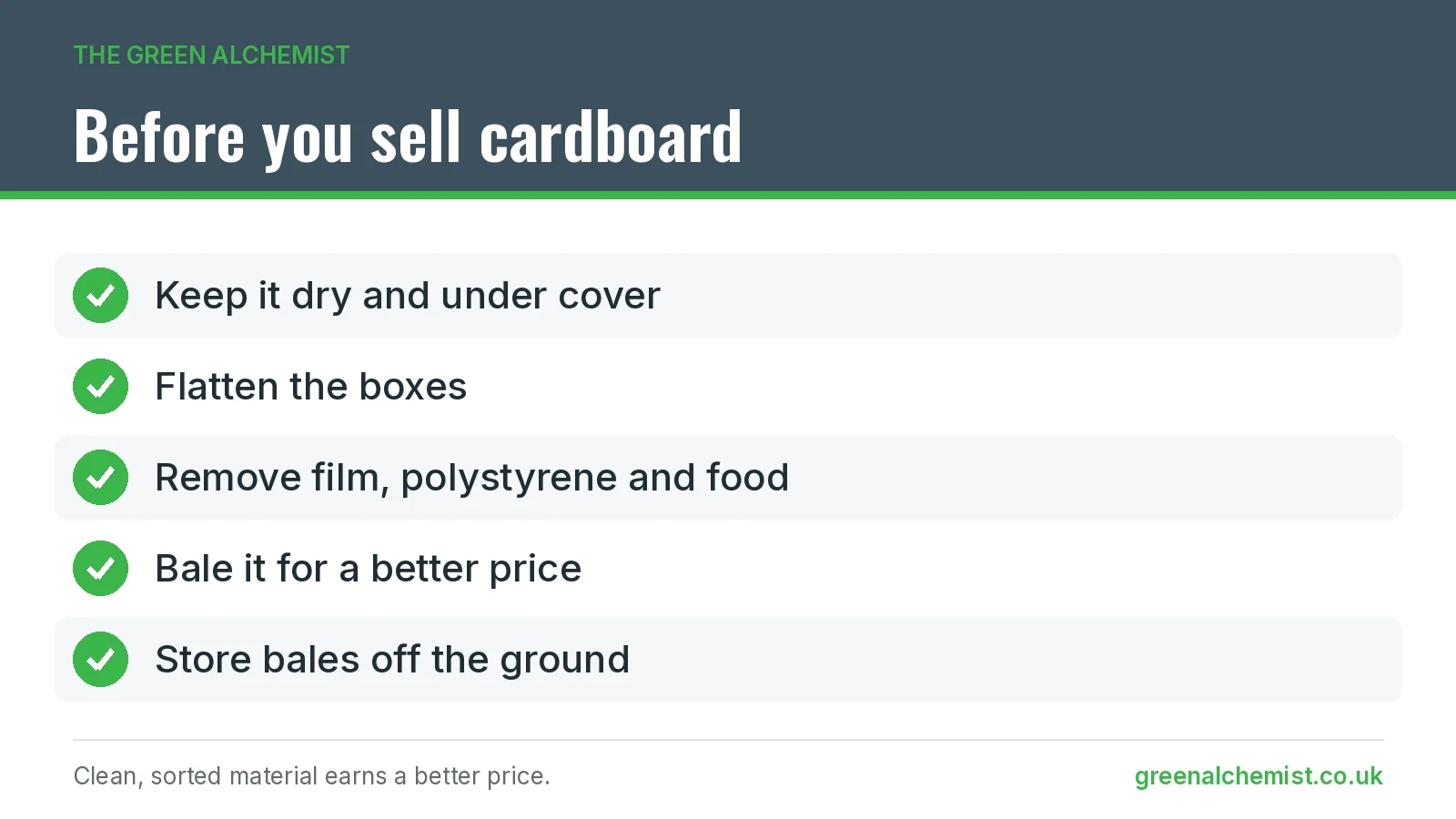
- Keep it dry and under cover from the moment it becomes waste.
- Flatten boxes and remove plastic film, polystyrene, strapping and food.
- Bale it. A small vertical baler suits low volumes, and mill size bales earn the best price.
- Store bales off the ground and away from rain.
- Keep white paper and other grades separate from cardboard.
- Note bale counts and weights so that buyers can quote accurately.
Your legal duties when you sell cardboard
- Duty of care. Your business must store its waste safely and hand it only to someone authorised to take it. See the official guidance.
- Registered carrier. Whoever collects your material must be a registered waste carrier. Check the public register before the first collection.
- Waste transfer note. Complete one for every load, or a season ticket for regular collections, and keep it for two years.
- Carrying it yourself. If you regularly transport your own business waste you must register as a waste carrier. In England this is free when you only carry waste your own business produced, unless it is construction or demolition waste.
- Separation at work. In England, workplaces must keep dry recyclables, food waste and non recyclable waste apart. The rules began on 31 March 2025, and firms with fewer than 10 full time equivalent employees have until 31 March 2027. Read the rules.
- Digital waste tracking. Since 1 October 2026, permitted sites that receive waste in England and Wales must record each load in the government's digital service. Carriers and dealers are due to follow in a later phase, so keep your transfer notes.
Rules differ slightly in Scotland, Wales and Northern Ireland. This is a plain English summary, not legal advice.
How to sell cardboard on The Green Alchemist
- Register your business on The Green Alchemist.
- Create a selling listing with the grade, quantity, location and a clear photo of your cardboard and paper.
- Browse the directory of waste processors to find buyers and carriers who handle cardboard and paper, and contact them directly.
- Compare offers on price, collection and payment terms, and check each buyer's registration.
- Agree the collection, complete the waste transfer note and get paid by bank transfer.
Register and list your cardboard and paper
Frequently asked questions
How much cardboard do I need before someone will pay for it?
Loose cardboard in small volumes is usually collected free or for a small charge. Rebates begin once you can bale it and store enough for a full collection.
Do tape and labels matter?
No. Small amounts of tape and labels are accepted. Plastic film, polystyrene and food are the problems.
Can wet cardboard be recycled?
It can, but mills pay less for wet loads and may reject them, so keep cardboard under cover.
Do I need a baler?
Not to recycle cardboard, but baling is what turns it into a material buyers pay for. Many suppliers rent balers, so compare the rental with the saving.
Related guides: Office waste, Sell plastic waste, Cut your waste costs.